
AI Accounting Landscape 2026
The 2026 AI accounting landscape mapped — from bookkeeping bots to tax automation. See which tools are leading and where the market is headed.
The integration of AI in accounting has become more prevalent than ever, leaving many professionals wondering if they’ll be left behind. The fear of obsolescence is real, with accounting AI systems becoming increasingly sophisticated and capable of handling complex tasks that were once the domain of human experts. But what if I told you that this technological revolution isn’t a threat, but an opportunity? The AI accounting landscape of 2026 isn’t about replacing accountants—it’s about empowering them. By understanding and embracing these advancements, you can position yourself at the forefront of a transformative era in finance. Let’s explore how AI is reshaping the accounting world and how you can leverage these tools to enhance your career and deliver unparalleled value to your clients.
Market overview
As finance professionals, we’re witnessing a seismic shift in our industry. The market map we’ve just explored isn’t just a collection of logos—it’s a roadmap to the future of accounting. But what does this mean for you and your career?
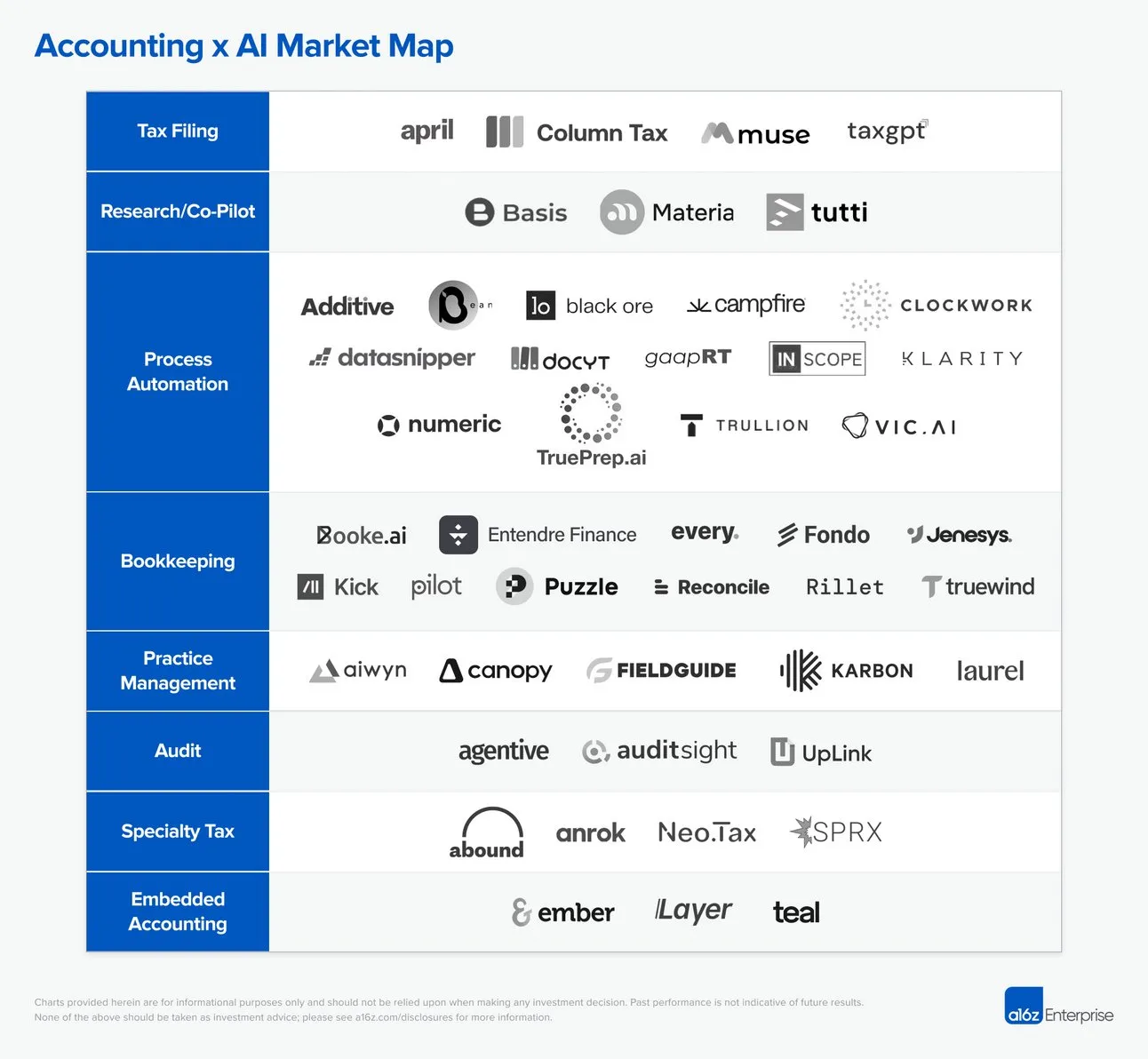
Let’s break it down:
1. Tax Filing: The New Frontier of Compliance
AI-powered tax tools are not just about filling in forms faster. They’re about:
- Predictive analytics for tax liability
- Real-time regulatory updates
- Anomaly detection to flag potential audit triggers
The real game-changer? These tools are learning from every return filed, continuously improving their accuracy and insights.
2. Research Co-Pilots: Your AI-Powered Wingman
Forget static databases. Today’s AI research assistants are:
- Contextually aware, understanding the nuances of your query
- Proactively surfacing relevant case studies and precedents
- Synthesizing complex regulatory changes into actionable insights
This isn’t just faster research; it’s smarter research, allowing professionals to spend less time searching and more time strategizing.
3. Process Automation: Beyond the Basics
We’re moving past simple RPA (Robotic Process Automation) to intelligent process orchestration:
- Self-optimizing workflows that adapt to bottlenecks
- Natural language processing for unstructured data extraction
- Cognitive automation that can handle exceptions and edge cases
The result? Finance teams can focus on high-value analysis rather than data wrangling. We have divided this category in a few dedicated categories:
4. AI-Powered Bookkeeping: The End of Data Entry?
Modern AI bookkeeping isn’t just about categorizing transactions. It’s about:
- Predictive cash flow modeling
- Automated reconciliations with machine learning-driven matching
- Intelligent expense management with policy enforcement
This level of automation is transforming bookkeeping from a cost center to a strategic asset.
5. Practice Management: The AI-Augmented Firm
AI is reshaping how accounting practices operate:
- Dynamic resource allocation based on real-time capacity and complexity
- Predictive analytics for client churn and satisfaction
- Automated knowledge management and best practice sharing
The firms that leverage these tools effectively will have a significant competitive edge in talent retention and client service.
6. Audit: From Sampling to 100% Coverage
AI is revolutionizing the audit process:
- Continuous monitoring instead of point-in-time audits
- Anomaly detection at scale, flagging potential issues in real-time
- Predictive risk assessment to focus human expertise where it’s needed most
This shift promises not just more efficient audits, but more effective ones, potentially reshaping the very nature of assurance services.
7. Specialty Tax: Complexity Meets AI
In areas like transfer pricing, R&D credits, and international tax, AI is:
- Automating scenario modeling for optimal tax structures
- Providing real-time impact analysis of policy changes
- Enhancing documentation with NLP-powered narrative generation
These tools are turning specialty tax from a compliance necessity into a strategic advantage.
8. Embedded Accounting: Finance as a Service
The future of accounting isn’t just in dedicated tools, but in AI-powered financial intelligence embedded directly into business processes:
- Real-time financial impact analysis in operational systems
- Predictive modeling integrated into strategic planning tools
- Automated compliance checks built into transaction systems
This integration promises to make financial intelligence ubiquitous across organizations.
The AI revolution in accounting isn’t just changing how we work; it’s redefining what it means to be a finance professional. The successful accountants of tomorrow won’t just be experts in GAAP or IFRS; they’ll be strategic advisors, leveraging AI to provide insights that drive business value.
As we navigate this new landscape, the key will be to embrace these tools not as replacements, but as amplifiers of human expertise. The future belongs to those who can blend the analytical power of AI with the strategic insight and ethical judgment that only humans can provide.
The question isn’t whether AI will transform accounting—it’s already happening. The real question is: how will you leverage these tools to stay ahead of the curve?
Ready to explore the tools shaping this landscape? Browse our complete directory of AI accounting apps to compare features, pricing, and reviews across every category — or start with the best AI accounting software for 2026.
Explore Related AI Tools
Related Articles
We Analyzed 74 AI AP Automation Tools in 2026 — Here's the Data
Pricing, integrations, free tiers, compliance and feature overlap across 74 AI accounts payable tools — sourced from our own product database, not vendor marketing.

Best Bank Statement Converters in 2026: PDF to Excel, CSV & OFX
Compare the best bank statement converters for 2026. Convert PDF bank statements to Excel, CSV, OFX & QBO with 99.6% accuracy. Free options included.

15 Best AI Accounting Software Tools for 2026 (Ranked & Compared)
We tested 15 AI accounting tools and ranked them by automation, accuracy & value. Honest comparison with pricing, pros, cons, and who each tool is best for.